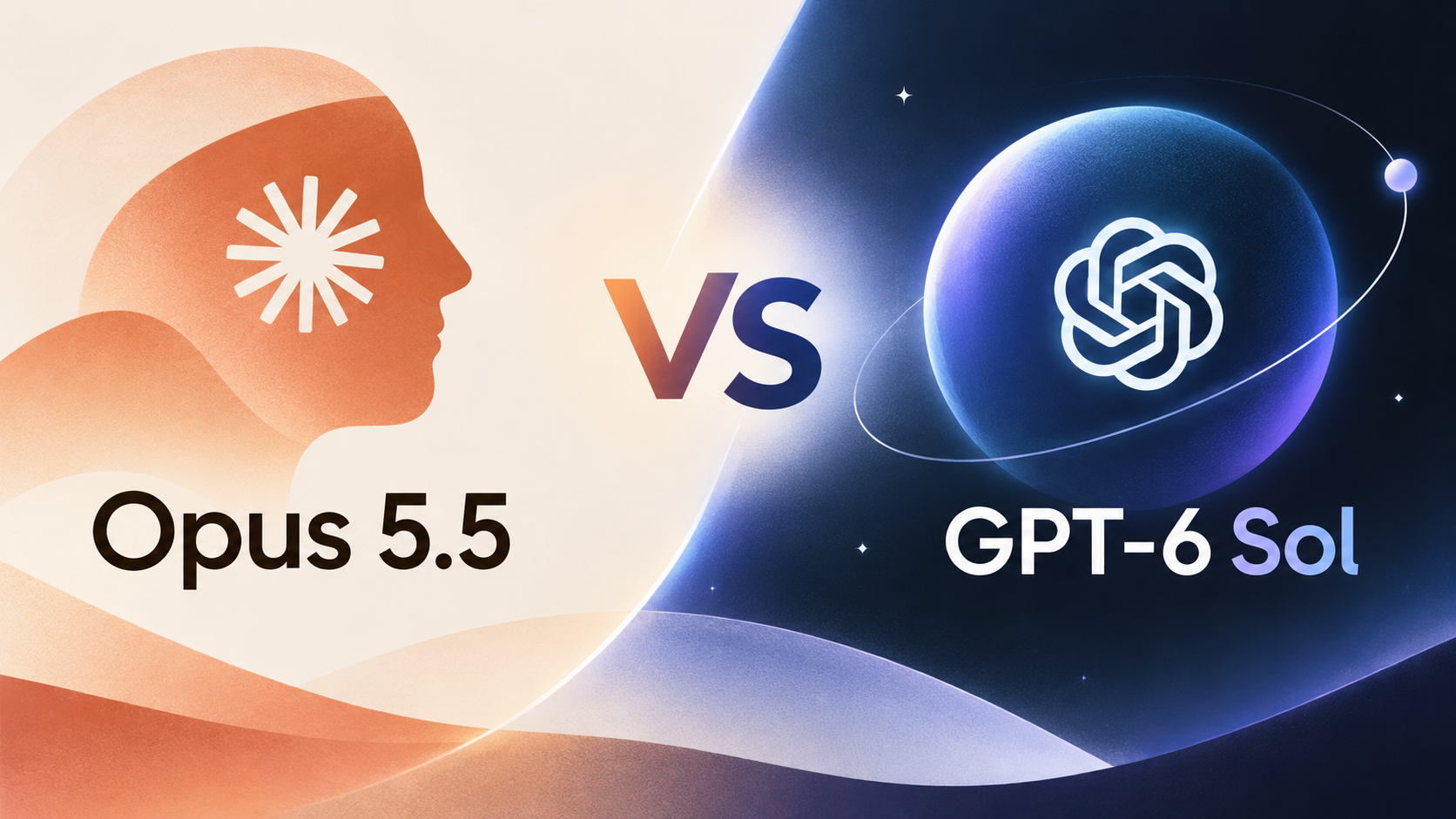
Opus 5.5 vs GPT-6 Sol: Price, Coding & Agents

By Alex Morgan
MyClaw Editorial
MyClaw
Run Best-in-Class AI Agents Now
Run OpenClaw or Hermes Agent on managed MyClaw hosting, so your AI agent stays online, updated, and ready for real work.
Start HostingAI Takeaway
- What are Claude Opus 5.5 and GPT-6 Sol?Anthropic’s
claude-opus-5-5and OpenAI’sgpt-6-sol, both launched September 22, 2026 for coding and agent work. Opus 5.5 is not Opus 5; Sol is not GPT-5.6 Sol or GPT-6 Astra. - Which model should you try first for most agent jobs?Start with GPT-6 Sol when volume and list rates dominate. Start with Claude Opus 5.5 when first-pass quality or long-horizon judgment matters more than sticker price.
- How do official list prices compare for equal uncached tokens?Opus 5.5 lists $4 / $20 per million input / output tokens. GPT-6 Sol lists $2 / $10—half—before long-context surcharges, tools, or thinking tokens.
- Does a higher bench score mean you should default to Opus 5.5?No. Cost per accepted task, effort setting, retries, and Sol’s long-context rules can flip the pick even when max-effort tables favor Opus.
- Can you run both Claude Opus 5.5 and GPT-6 Sol on MyClaw?Yes. MyClaw Chat and hosted OpenClaw agents run both, so you can test the same job on each ID.
Lock the IDs: Opus 5.5 Is Not Opus 5
Lock the strings first. Claude Opus 5.5 is claude-opus-5-5 (OpenRouter: anthropic/claude-opus-5.5). GPT-6 Sol is gpt-6-sol (OpenRouter: openai/gpt-6-sol). Both shipped September 22, 2026 in different ladders: Opus 5.5 opens Anthropic’s Claude 5.5 Opus line; Sol is OpenAI’s cost-efficient high-end GPT-6 tier—below Astra, above Luna.
The predecessor pair lives on GPT-6 Sol vs Claude Opus 5. This page stays on Opus 5.5. Sol is not GPT-5.6 Sol, and Opus 5.5 is not a Fable or Mythos escalate.
What Each Model Is Built For
Opus 5.5 is built for long-running agentic coding and knowledge work. Adaptive thinking stays on; effort defaults to medium. Context is 1M tokens with up to 128K output—strong for multi-step codebase changes, review, and dense charts or documents.
Sol targets the same job class at a lower GPT-6 sticker. Effort runs from none to max (default medium). Context is 1.05M tokens with up to 128K output. On the Responses API it exposes computer use, hosted shell, MCP, and related tools, so OpenAI-native agents can stay on Sol without jumping to Astra.
Specs and List Pricing Side by Side
Vendor and OpenRouter list rates (re-checked September 24, 2026) are marketplace tokens—not a MyClaw hosting invoice. Batch, flex, fast, and regional tiers can differ.
| Axis | Claude Opus 5.5 | GPT-6 Sol |
|---|---|---|
| API ID | claude-opus-5-5 | gpt-6-sol |
| Context / max out | 1M / 128K | 1.05M / 128K |
| List $/1M in·out | $4 / $20 | $2 / $10 |
| Cache read (list) | $0.20 | $0.20 |
| Thinking / effort | Adaptive always on; default medium | Effort none→max; default medium |
| Long-context list quirk | Flat Anthropic list across the 1M window | >272K input: 2× input and cache, 1.5× output for the full request |
| Modalities | Text + image (+ files) → text | Text + image (+ files) → text |
On equal uncached tokens, Sol’s Standard list is half of Opus 5.5. That gap shrinks or vanishes if Sol’s prompt crosses 272K input, if one ID burns far more thinking or output tokens, or if one needs three retries and the other finishes once. For Sol-only depth, see the GPT-6 Sol review. The Claude Opus 5 review covers lineage and Fast-mode caveats on the prior Opus ID—do not treat Opus 5 stickers as Opus 5.5.
Claude Opus 5.5: Pros and Cons for Hard Jobs
Pros:
- Early independent max-effort composites often favor Opus—Artificial Analysis’s Intelligence Index sits near 58 for Opus 5.5 at max vs near 48 for Sol at max (directional, not an invoice)
- Flat list rates across the full 1M window; cache reads at $0.20 per million
- Strong fit for sustained agentic coding, careful review, and dense visual or document work
- About 20% lower list in/out than Opus 5, with cheaper cache reads—an upgrade path for Opus 5 shops
Cons:
- Roughly 2× Sol’s list in/out for equal uncached tokens
- Maximum effort can burn large thinking and output budgets per task
- Adaptive thinking cannot be turned off; Opus 5 migrations break forced tool choice, computer toolsets, and preserved thinking
- Harder to justify on high-volume, low-ambiguity pipelines where retries are cheap
GPT-6 Sol: Pros and Cons for Cost-Sensitive Agents

Pros:
- $2 / $10 Standard list—the clear cost and volume play under Astra
- Optional low or
noneeffort for throughput, plus Batch and Flex discount paths on OpenAI - Full Responses tool surface for OpenAI-native agents (computer use, shell, MCP, and related tools)
- Strong fit when dollars per accepted task matter more than max-effort leaderboard gaps
Cons:
- Trails Opus 5.5 on many early max-effort coding and agent composites
- Prompts above 272K input lift the whole request to 2× input/cache and 1.5× output—enough to erase the half-price sticker
- High effort can delay the first answer token; Chat Completions only supports function calling at effort
none - Not the escalate ID—Astra still sits above for the hardest OpenAI jobs
Coding, Agents, and Cost Per Accepted Task
Production picks turn on first-pass merge quality, terminal and computer-use reliability, whether an automation ends in the right state, cleanup time, and tokens burned at each effort setting—not who topped a launch chart.
Independent and vendor benches diverge once effort knobs differ. Artificial Analysis’s early max-effort Intelligence Index favors Opus 5.5 over Sol; OpenAI’s AutomationBench-style stories emphasize Sol’s cost per finished workflow. Treat both as reasons to run matched jobs, not as the pass/fail rule.
Illustrative list-rate example only: 50,000 uncached input tokens and 10,000 billable output tokens cost about $0.40 on Opus 5.5 ($4 × 0.05 + $20 × 0.01) versus about $0.20 on Sol ($2 × 0.05 + $10 × 0.01), before tools, cache, thinking tokens, or Sol’s long-context surcharge. If Sol needs three attempts and Opus finishes once, Sol’s model-token bill is higher despite the cheaper sticker. For recurring loops, trim stale context and score accepted results the way the OpenClaw token-cost guide frames hygiene.
Prefer Sol for classification, extraction, ticket drafts, and high-volume coding agents with a clear pass/fail. Prefer Opus 5.5 for ambiguous refactors, architecture review, and long-horizon agents where a miss is expensive.
Run the Same Job in a MyClaw Agent Workspace
MyClaw hosts a private, always-on OpenClaw agent so files, tools, and schedules stay up while you swap IDs. Hosting and model usage bill separately—see MyClaw pricing for the host. Soft guest access on MyClaw Chat lets you try either model before you pin a default.
Step 1: Freeze One Measurable Job and Pass/Fail Rule
Pick one coding, review, or tool-heavy outcome you can score the same way twice—a failing test, a bounded refactor, a sourced memo, or a scheduled monitor. Prefer work you already run often enough that retries and cleanup show up in the real cost.
Step 2: Run GPT-6 Sol and Opus 5.5 on the Same Inputs
Keep the prompt, files, tools, and permissions identical. Run the job on gpt-6-sol, then switch to claude-opus-5-5 in the same workspace. Pin effort on both sides so you are not comparing medium Sol to max Opus by accident.
Step 3: Keep the Workspace and Score Cost Per Accepted Result
Leave diffs, logs, and artifacts in the hosted workspace so the next pass starts from the work, not a blank chat. Record pass or fail, billed usage, tool charges, retries, and manual edits. Keep the cheaper ID that clears the bar; escalate only when failure cost justifies it. For routing across OpenClaw workloads, see Best model for OpenClaw.
Pick by Failure Cost, Then Keep a Fallback
| If you need… | Start with… |
|---|---|
| High-volume, cost-sensitive coding or business agents | GPT-6 Sol |
| Hard coding, careful review, long-horizon judgment | Claude Opus 5.5 |
| Jobs already passing on Sol or Opus 5 | Stay; do not auto-upgrade |
| Overnight or always-on execution | A hosted OpenClaw workspace, then swap the model |
Change the model when the matched job says so. Leave the workspace alone so logs and files travel with you. Re-test when list rates or IDs move, and run both Claude Opus 5.5 and GPT-6 Sol on MyClaw when you want the same tools on either side.
Skip the Setup, Run Best-in-Class AI Agents Now
Launch a managed OpenClaw or Hermes Agent workspace in minutes, with always-on hosting, updates, and support handled by MyClaw.
Get Started