Opus 5.5 vs Fable 5.1 for Coding: Benchmarks, Cost Per Task, and Which to Pick

By Emma Reed
MyClaw Editorial
MyClaw
Run Best-in-Class AI Agents Now
Run OpenClaw or Hermes Agent on managed MyClaw hosting, so your AI agent stays online, updated, and ready for real work.
Start HostingAI Takeaway
- Which model is better for coding? Claude Opus 5.5 for most work. On Anthropic's own launch benchmarks (Sep 2026), it leads Claude Fable 5.1 on Terminal-Bench 4.0 by 66.4% to 55.8%, and it costs less per token.
- Do independent tests agree? Mostly, with a smaller gap. Artificial Analysis measured Opus 5.5 at 59.6% on Terminal-Bench 4.0 and Vals AI at 61.62%, both below Anthropic's figure.
- Is Fable 5.1 ever the better pick? Yes. In The New Stack's hands-on test (2026), Fable 5.1 solved every concurrency-bug run, finished faster, and used fewer output tokens, while Opus 5.5 failed two of five.
- How do costs compare? At list price, Nov 2026, Opus 5.5 costs $4/$20 per million input/output tokens and Fable 5.1 costs $10/$50, but total cost per task depends on how many tokens each model spends.
- Can you get coding help without running a server? A hosted OpenClaw or Hermes agent on MyClaw stays on around the clock, uses popular LLMs for free, and answers coding questions on Telegram, WhatsApp, email, or the browser.
Opus 5.5 vs Fable 5.1 for Coding at a Glance
| Dimension | Claude Opus 5.5 | Claude Fable 5.1 |
|---|---|---|
| Release date | September 22, 2026 | September 1, 2026 |
| Model ID | claude-opus-5-5 | claude-fable-5-1 |
| Context / max output | 1M / 128K tokens | 1M / 128K tokens |
| Default effort | Medium | High |
| Terminal-Bench 4.0 (Anthropic, Sep 2026) | 66.4% | 55.8% |
| FrontierCode v1.1 (Anthropic, Sep 2026) | 54.4% | 50.3% |
| CursorBench 4.0 (Anthropic, Sep 2026) | 57.8% | 51.8% |
| List price, Nov 2026 (input / output per 1M) | $4 / $20 | $10 / $50 |
| Typical failure mode (Snorkel AI) | Wrong conclusions, wrong tool arguments | Stopping early, unrecovered errors |
| Best fit | Everyday agentic coding, refactors, review | Hard concurrency work, faster single runs |
For a general comparison beyond coding, see Opus 5.5 vs Fable 5.1.
Coding Benchmarks Compared
Anthropic's launch table for Opus 5.5 (Sep 22, 2026) puts it ahead of Fable 5.1 on every coding benchmark listed. The largest gap is Terminal-Bench 4.0, which measures an agent working through multi-step tasks in a real shell: 66.4% for Opus 5.5 at xhigh effort versus 55.8% for Fable 5.1. On FrontierCode v1.1 the margin is 54.4% to 50.3%, and on CursorBench 4.0 it is 57.8% to 51.8%. Anthropic itself notes the gap between the two models is narrower than these scores suggest.
Independent runs support that caution. Artificial Analysis measured Opus 5.5 at 59.6% on Terminal-Bench 4.0, and Vals AI measured 61.62%, both lower than Anthropic's number, though still ahead of Fable 5.1's published score.
Snorkel AI's trajectory analysis (2026) adds a different view. Across all runs on its expert task set, Opus 5.5 passed 68% versus 49% for Fable 5.1, yet first-attempt pass rates were nearly level at 60.7% and 61.5%. In other words, Opus 5.5 is more consistent across repeated attempts, not dramatically smarter on a single try. For a broader take on the model, read the Opus 5.5 review.
Agentic Coding and Long Runs
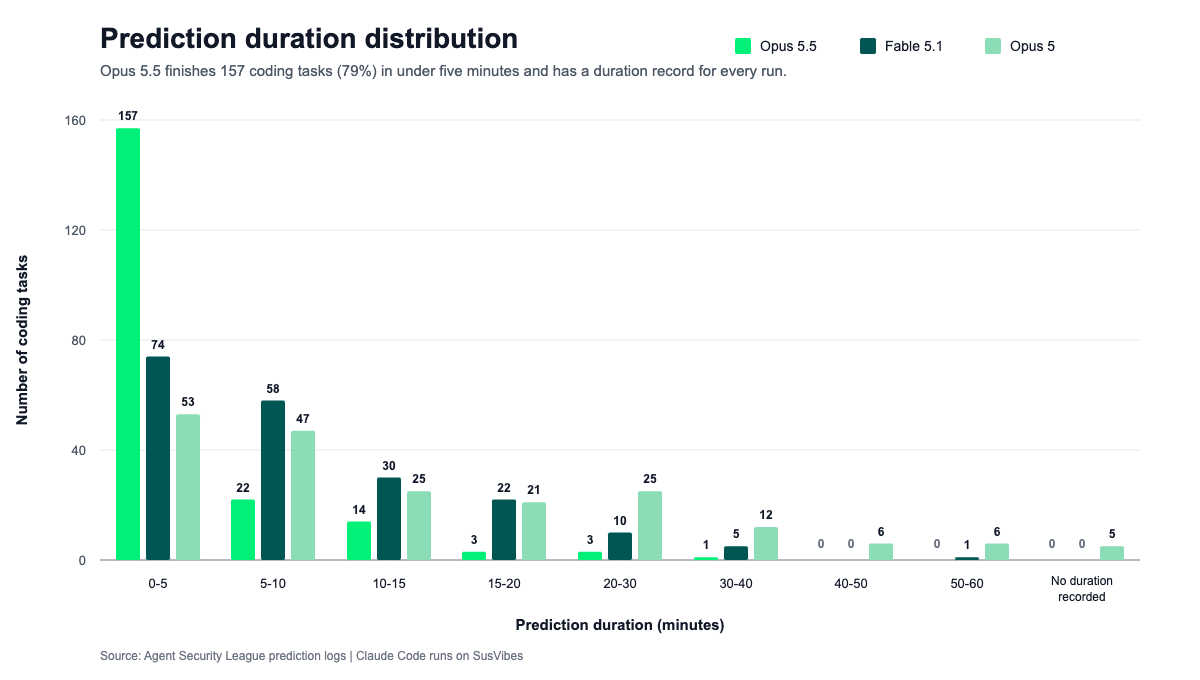
Both models are built for agentic coding, where the model plans, edits files, runs commands, and iterates for minutes or hours. Anthropic's documentation describes Opus 5.5 as strongest on multistep work in a real repository, such as carrying a change through a large code base until its tests pass, and says it sustains multihour audits and migrations with parallel subagents better than Opus 5. It also generates output more than 30% faster than Opus 5.
Fable 5.1 targets the same territory, including whole-codebase work and long agent harnesses. Where it falls short, Snorkel AI found the pattern was mid-run: premature termination and errors the model did not recover from. Opus 5.5's failures clustered at the edges instead, with malformed first responses and wrong tool arguments.
How you run these models matters as much as which one you choose. If you are deciding on the coding environment itself, Claude Code vs Cursor covers the trade-offs.
Debugging and Code Review
The New Stack ran both models through three coding tests, five runs each at maximum effort (2026). On an agentic bug fix, both were perfect in all five runs, but Opus 5.5 cost $0.75 per run against $1.50 for Fable 5.1 and handled a flaky test correctly. A resolver spec also ended in a tie on accuracy.
The concurrency test went the other way. Fable 5.1 fixed the asyncio bugs in all five runs, while Opus 5.5 succeeded in three and twice ran out of room and returned nothing. If your work involves tricky concurrency or race conditions, that result is worth weighing.
For code review, Anthropic reports early testers saw Opus 5.5 catch more bugs than Opus 5 with fewer false alarms, and explain its changes in plain language. Snorkel AI's trajectory analysis adds a caution worth applying to any model: failing runs often treated a command that ran without errors as proof the output was correct. For more on Fable 5.1's strengths, see the Fable 5.1 review.

Cost Per Task, Not Per Token
At list price, Nov 2026, Opus 5.5 is far less expensive per token: $4 input and $20 output per million, with cache reads at $0.20, versus $10, $50, and $0.25 for Fable 5.1. Per-token price is only half the story.
In The New Stack's 15 runs, Opus 5.5 cost $22.07 in total versus $28.14 for Fable 5.1, about 22% less. But Opus 5.5 wrote 2.2 times as many output tokens and took 67% longer to finish. Fable 5.1 tends to reach an answer with less output, which narrows the price gap on hard tasks.
The practical approach is to measure cost per completed task on your own workload, including retries, rather than comparing token prices alone.
Effort Settings for Coding
Thinking is always on for both models, so effort is the main control over depth, speed, and cost. Opus 5.5 defaults to medium, and Anthropic says that at medium it matches or beats Opus 5 at high effort on coding tasks, with low coming close at much lower cost on several evaluations. Fable 5.1 defaults to high.
Set effort explicitly on both models rather than carrying settings over from older ones, and test a few levels on real tasks. At xhigh or max, leave generous room in max_tokens for thinking; running out of room is exactly how Opus 5.5 returned empty results in the concurrency test. The Opus 5.5 prompting guide walks through effort calibration in detail.
Which Model to Pick for Each Coding Job
- New features and everyday tickets: Opus 5.5 at medium effort.
- Large refactors and migrations: Opus 5.5 at high effort, with subagents where your tooling supports them.
- Code review: Opus 5.5.
- Terminal-heavy tasks: Opus 5.5, given its Terminal-Bench lead.
- Concurrency and race-condition bugs: Fable 5.1, or Opus 5.5 with a higher token budget.
- Time-sensitive single runs: Fable 5.1, which finished faster in hands-on testing.
If your work also covers interfaces and visual review, Opus 5.5 vs Fable 5.1 for design compares the two on that side.
Run Coding Jobs on an Always-On Agent with MyClaw
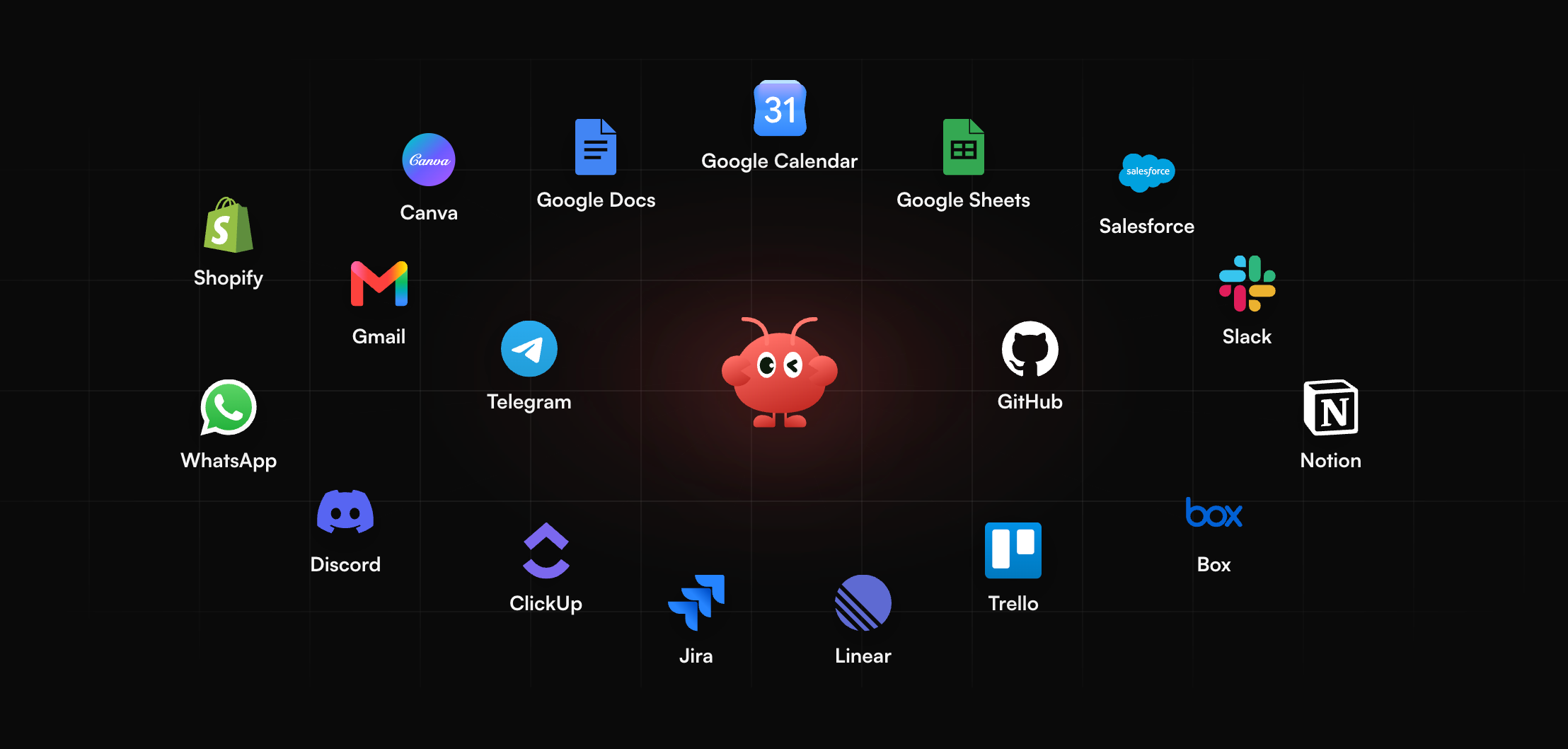
Coding questions do not wait until you are back at your desk. MyClaw runs a hosted OpenClaw or Hermes agent that stays on around the clock, works with popular LLMs for free, and answers you on Telegram, WhatsApp, email, or in the browser. It can also run scheduled jobs, with no server work on your side.
In practice, you might paste a stack trace from your phone and get an explanation of the likely cause while you are away from your laptop, or schedule a weekly reminder that summarizes the coding topics and tasks you asked it to track.
- Create your agent. Sign up and choose OpenClaw or Hermes.
- Pick your model and connect a channel. Select from the models available to your account, then link Telegram, WhatsApp, email, or use the browser.
- Send a coding question or set a schedule. Paste an error or code snippet, or set up a recurring digest.
Conclusion
For most coding work, Opus 5.5 is the stronger default. It leads on Anthropic's coding benchmarks, holds a smaller but real lead in independent tests, and costs less per token, and in The New Stack's tests less in total. Fable 5.1 still earns a place for hard concurrency problems and runs where speed matters more than spend. Start with Opus 5.5 at medium effort, measure cost per completed task, and switch only when your own results show a clear reason.
Skip the Setup, Run Best-in-Class AI Agents Now
Launch a managed OpenClaw or Hermes Agent workspace in minutes, with always-on hosting, updates, and support handled by MyClaw.
Get Started