
Claude Opus 5.5 Review: Is the Upgrade Worth It?

By Alex Morgan
MyClaw Editorial
MyClaw
Run Best-in-Class AI Agents Now
Run OpenClaw or Hermes Agent on managed MyClaw hosting, so your AI agent stays online, updated, and ready for real work.
Start HostingAI Takeaway
- What is Opus 5.5 best for? Long coding, research, and agent tasks that need planning, tool use, and careful checking.
- Is it cheaper than Opus 5? API input and output rates are 20% lower, and cache reads are 60% lower. Your cost per completed task still depends on effort and token use.
- How strong is it? Anthropic reports substantial gains over Opus 5. Artificial Analysis placed Opus 5.5 first on its September 22 Intelligence Index run at max effort. Neither result settles how it will perform on your work.
- Should you switch? Test a representative job at medium and high effort. If you use the API, check thinking, tool-choice, and computer-use settings before changing the model ID.
What Changed in Claude Opus 5.5
Release, Access, and Core Specifications
Anthropic released Claude Opus 5.5 on September 22, 2026. Its API model ID is claude-opus-5-5. It keeps Opus 5's one-million-token context window and 128,000-token maximum output, so the upgrade is about behavior and efficiency rather than a larger working window. It accepts text and images. Adaptive thinking is always on, with five effort levels: low, medium, high, xhigh, and max. The default is medium.
Opus 5.5 is available through Claude products, the API, and major cloud platforms. Claude subscriptions and API usage are billed separately. Subscription capacity depends on prompt length, files, and tool use, so there is no fixed message count.
The Meaningful Upgrade over Opus 5
The upgrade matters most when a model must sustain a plan across many steps. Anthropic reports stronger agentic coding and knowledge work, clearer writing, and output generation more than 30% faster than Opus 5. Anthropic says typical workloads at default settings cost about 40% less. Its docs list Opus 5 at high effort by default and Opus 5.5 at medium, so compare them at the same effort before attributing the entire saving to the new model.
The previous Opus 5 review described strong persistence on hard debugging, alongside a tendency to over-check simple requests. Opus 5.5 looks more efficient and easier to follow, but routine summaries and extraction still rarely justify an Opus-class model.
What Do the Performance Tests Show?
Coding and Long-Running Agents
Anthropic reports 66.4% on Terminal-Bench 4.0 for Opus 5.5 at xhigh effort, versus 52.3% for Opus 5 in its setup. Its reported FrontierCode v1.1 score rises from 48.0% to 54.4%. These tests are useful signals for terminal work and code changes across a repository, but they are not a promise that every migration or bug fix will improve by the same margin.
Artificial Analysis independently gave Opus 5.5 a score of 58 on its Intelligence Index at max effort, the highest in its September 22 results. It led six of the index's ten evaluations, but not all of them. Its Terminal-Bench 4.0 figure was 59.6%, below Anthropic's 66.4%. The reports use different test setups and effort levels, so these figures should not be combined into one universal win rate.
The strongest case is for repository-wide changes, multi-source audits, and agents that must recover after failed tool calls. Short, low-risk jobs are less likely to benefit.
What Benchmarks Cannot Settle
These are published tests, not original hands-on runs. The release is recent, and benchmark tasks may differ from yours. Anthropic says its charts overstate the everyday gap between Opus 5.5 and Fable 5.1.
Compare models on one job you know how to judge. Keep files, tools, instructions, and acceptance criteria the same. Record correctness, rework, elapsed time, total tokens, and any fallback model that actually completed the task. The older Fable 5.1 vs Opus 5 comparison illustrates this approach, though its recommendation predates Opus 5.5.
Opus 5.5 Pricing: Cheaper Tokens, Variable Task Cost
API Rates, Caching, and Effort
Standard Claude API rates are $4 per million input tokens and $20 per million output tokens, down from $5 and $25 for Opus 5. A five-minute cache write costs $5 per million tokens; a cache read costs $0.20, down from $0.50. Anthropic also offers a faster mode at $8 input and $40 output per million tokens. That premium buys speed, not a different model capability.
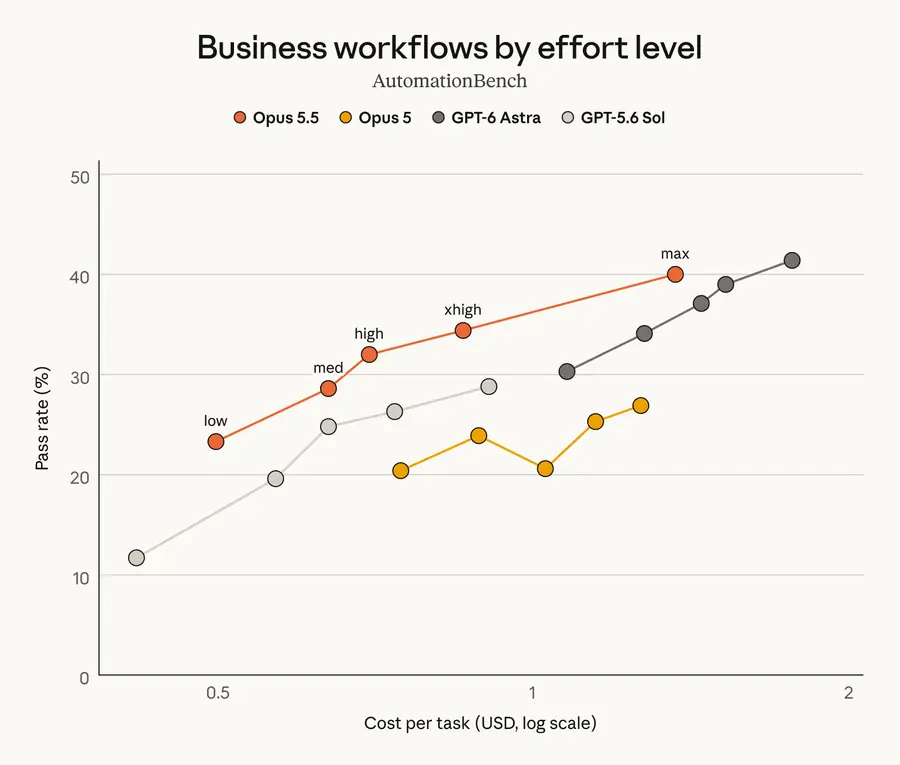
Lower rates are only half the bill. At max effort, Artificial Analysis measured roughly 119,000 output tokens per Intelligence Index task for Opus 5.5, against roughly 73,000 for Opus 5. Cost per task was therefore about level in that test despite cheaper tokens. Anthropic's default-setting estimate and this max-effort benchmark describe different task mixes and settings.
For cost comparisons, hold effort constant before changing models; then test higher effort only where it improves the finished result. In recurring agents, repeated context can dominate the bill. The OpenClaw token cost guide covers context control and routing routine work to lighter models. Its savings examples are illustrative, not guaranteed.
When to Choose Opus 5.5, Sonnet 5, or Fable 5.1
| Model | Best Fit |
|---|---|
| Opus 5.5 | A demanding default for multi-step coding and knowledge work; test medium and high effort first. |
| Sonnet 5 | Faster, lower-cost runs where volume or response time matters more than the last increment of quality. |
| Fable 5.1 | A particularly hard, long-horizon task that Opus 5.5 still cannot finish well at higher effort. |
Anthropic's model guidance supports this starting point; your results should decide the final route. MyClaw's Sonnet 5 model page gives a lower-cost reference for everyday agent work.
What to Check Before Switching an API Agent
For a custom API agent, changing the model ID alone can break requests:
- Thinking: It cannot be disabled or assigned a manual token budget. Choose an effort level instead.
- Tool choice: Requests that force
anytool or a named tool are rejected. Useautowith strict tools or structured outputs. - Computer use: Claude API and Google Cloud integrations using
computer_20251124needcomputer_toolset_20260801and an updated agent loop. Check other platforms separately.
There is also a routing issue: on the Claude API, only Fable 5.1 and Mythos 5.1 can read Opus 5.5's thinking blocks after a fallback. Interfaces that show progress between tool calls may need to read the new progress blocks explicitly. Safeguard refusals can also change which model handles a task. Re-run a production-like test, inspect tool calls and refusals, and set effort explicitly so the new medium default does not silently change your baseline.
Run a Meaningful Opus 5.5 Agent Test with MyClaw
MyClaw provides a managed OpenClaw workspace for files, tools, and recurring agent work. Anthropic provides Opus 5.5. MyClaw's public model directory did not list Opus 5.5 when checked on September 23, 2026. Confirm that your configured provider and agent expose the exact model before planning a run. Hosting fees and AI token usage are separate.
Step 1: Give the Agent One Bounded Job
Start an OpenClaw workspace with only the files and tools the job needs. Pick a task with an observable result, such as reviewing a set of code changes against tests or synthesizing cited findings from a document folder. Define what success looks like, which actions require approval, and a spending limit.
Step 2: Check the Model, Then Run the Same Job Twice
If both Opus 5.5 and effort controls are available in your setup, run the identical task at medium and high effort. Keep instructions and tool access fixed. Compare correctness, recovery, time, tokens, and fallback. If effort control is unavailable, record the default setting rather than claiming an effort comparison. If the exact model is unavailable, defer the test.
Step 3: Keep the Setting That Finishes the Job Efficiently
Use the lowest effort that reliably passes your acceptance checks. Reserve Opus 5.5 for the difficult stage and assign routine preparation or formatting to a lighter model when the workflow permits it. Monitor both the hosting plan and separate AI usage before scheduling the task repeatedly.
Verdict: Who Should Move to Opus 5.5 Now?
Try Opus 5.5 for long coding jobs, multi-source analysis, or agents where mistakes cause costly rework. Published results justify a trial, while the best effort level and cost still depend on your task.
The useful next step is a controlled run on one task you already know how to judge. Choose the model and effort level by finished work, elapsed time, and total cost—then expand only after the result holds up in your own workflow.
Skip the Setup, Run Best-in-Class AI Agents Now
Launch a managed OpenClaw or Hermes Agent workspace in minutes, with always-on hosting, updates, and support handled by MyClaw.
Get Started