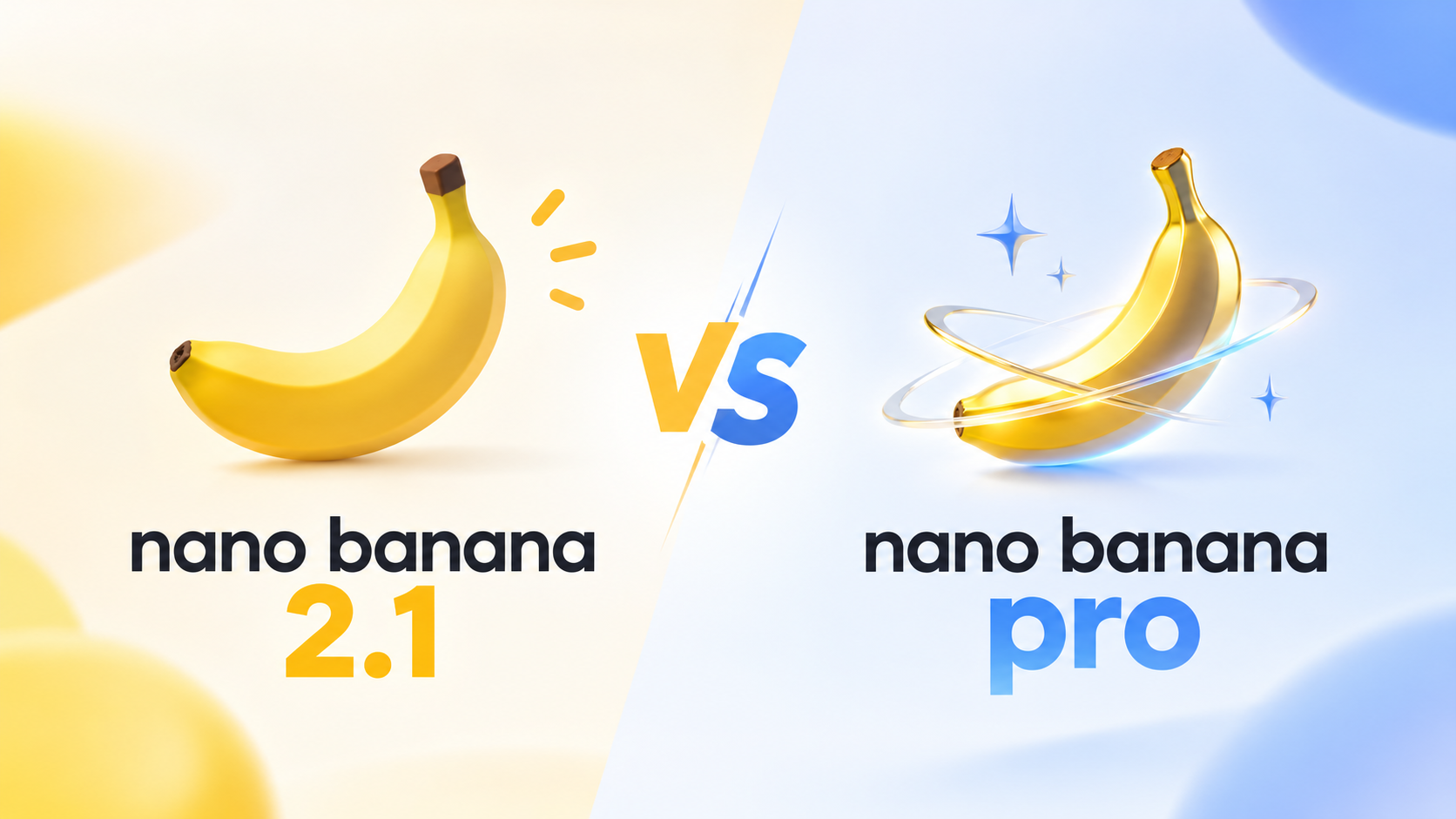
Nano Banana 2.1 vs Pro: Price, Quality & Which to Use

By Emma Reed
MyClaw Editorial
Compare in MyClaw
Compare Nano Banana 2.1 and Nano Banana Pro on your own images
Run the same brief in both models and compare text, references, edits, and cost before you switch.
AI Takeaway
- What is Nano Banana 2.1, and how does it relate to Nano Banana Pro?It is Google's Flash-tier image model,
gemini-nano-banana-2.1, generally available since October 6, 2026. Built on Gemini 3.6 Flash, it replaces Nano Banana 2. Nano Banana Pro, Google's Gemini 3 Pro Image model (gemini-3-pro-image), entered preview in November 2025 and reached general availability in May 2026. - How much cheaper is Nano Banana 2.1 than Nano Banana Pro?Google lists 2.1 at $0.0336, $0.0504 and $0.113 per 1K, 2K and 4K image. A Pro image costs $0.134 at 1K or 2K and $0.24 at 4K, again by Google's list. Batch mode halves every one of those rates.
- Does Nano Banana 2.1 make better images than Nano Banana Pro?Per Google's model card, 2.1 beats Pro on every row Google published, even with thinking switched off. No outside lab has confirmed those results yet.
- When should you still pick Nano Banana Pro over 2.1?Choose Pro for scenes with five recurring people, for up to three style reference images, or for long blocks of in-image text, which Google sold as a Pro strength at launch.
- Can you use Nano Banana 2.1 or Pro on MyClaw?Yes. You can pick either model in MyClaw Chat, send one prompt to each and judge the outputs side by side.
Nano Banana 2.1 vs Pro: Model IDs, Release Dates and Limits
Google dropped its usual naming with this release. Earlier Flash models had labels like "Gemini 3.1 Flash Image," but the new one ships under the nickname itself. Underneath, 2.1 runs on the Gemini 3.6 Flash text model, and Pro sits on Gemini 3 Pro.
| Nano Banana 2.1 | Nano Banana Pro | |
|---|---|---|
| API model ID | gemini-nano-banana-2.1 | gemini-3-pro-image |
| Base model | Gemini 3.6 Flash | Gemini 3 Pro |
| Released | Oct 6, 2026 (GA on day one) | Preview Nov 20, 2025; GA May 28, 2026 |
| Inputs | Text, image, video, PDF | Text, image |
| Input token limit | 131,072 | 65,536 |
| Output sizes | 1K, 2K, 4K | 1K, 2K, 4K |
| Thinking control | Minimal, medium (default), high | Supported, no level setting |
| Search grounding | Google Web and Image Search | Google Web Search |
| Batch API | Yes | Yes |
Teams moving off Nano Banana 2 should note two changes. Its 512px size does not exist on 2.1. Google also says 2.1 fixes the tiling artifacts that marred extreme 1:4, 4:1, 1:8 and 8:1 frames at 2K and 4K, which matters for tall banners and panoramas.
Nano Banana 2 was deprecated the day 2.1 arrived, though Google has not set a shutdown date. For the older lineup, our earlier piece maps how the previous Nano Banana tiers stacked up against Qwen.
Price Per Image: Nano Banana 2.1 Costs About a Quarter of Pro at 1K
Google bills image output by the token and publishes a per-image equivalent. These are its Gemini API list prices, Standard tier unless noted:
| Output size | Nano Banana 2.1 (Google) | Nano Banana Pro (Google) | 2.1 as share of Pro (computed) |
|---|---|---|---|
| 1K | $0.0336 | $0.134 | ~25% |
| 2K | $0.0504 | $0.134 | ~38% |
| 4K | $0.113 | $0.24 | ~47% |
| Batch, 1K / 2K / 4K | $0.0168 / $0.0252 / $0.0567 | $0.067 / $0.067 / $0.12 | about the same |
Bigger images narrow the gap. Pro charges one rate for 1K and 2K, while 2.1 climbs with each size step. Computed from Google's list prices, 1,000 images at 2K run $50.40 on 2.1 and $134 on Pro. At 4K, that batch costs $113 against $240.
Inputs follow the same pattern: Google charges $1.50 per million input tokens for 2.1 and $2.00 for Pro. Search grounding uses one Google rule for both, with 5,000 free requests a month shared across Gemini 3.x models and $14 per 1,000 after that.
For a non-Google reference point, compare OpenAI's per-image rates for GPT Image 2.5.
Image Quality: Google's Own Tests Rank 2.1 Above Pro
Google scored both models with side-by-side human ratings, reported as Elo, plus an automated factuality rater. Selected rows, all per Google's model card (October 2026):
| Test | 2.1 (Thinking) | 2.1 (No Thinking) | Pro |
|---|---|---|---|
| Overall Preference | 1050 | 1015 | 935 |
| Infographic Design | 1048 | 1001 | 912 |
| Infographic Factuality | 0.521 | 0.328 | 0.265 |
| General Editing | 1026 | 980 | 939 |
| Multi-Character Consistency | 1106 | 1068 | 1011 |
| Mask/Ink-Based Editing | 1049 | 1042 | 927 |
Look at the middle column. With thinking off, 2.1 still tops Pro on all ten rows in the card, so the faster setting gives up little on this test. Keep the source in mind, though: Google graded its own models, and no independent arena result had been checked when this was written.
Where Google Says Nano Banana 2.1 Still Slips
The card is candid about weak spots:
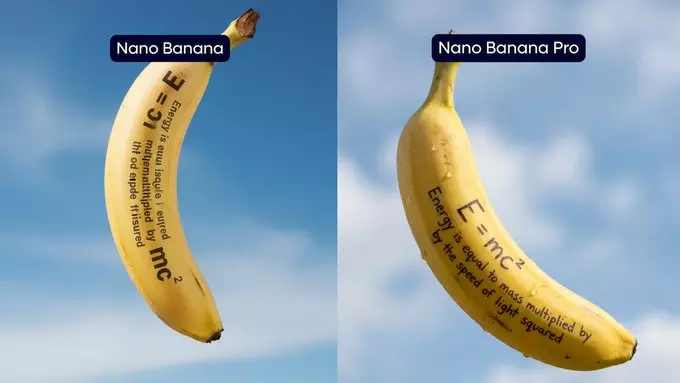
- Small text often blurs at 1K, and long paragraphs or page-length copy fall apart.
- Characters don't always match the input photos.
- Doodle or masked edits can leave ink behind or follow only part of the instruction.
- Subjects occasionally keep the pose from the source image.
- Left and right sometimes get swapped.
Text Rendering: Check Small Type at 2K Before You Switch
Google credits 2.1 with sharper text and more accurate infographic layouts. On infographic factuality it scores 0.521 to Pro's 0.265 per Google's model card, close to double (computed). Charts, explainers and labeled diagrams are natural fits.
Pro's argument is longer copy. At its November 2025 launch, Google called Pro its best model for legible in-image text, from a short tagline to a full paragraph, and demoed it translating the English on drink cans into Korean without touching the design. Since the 2.1 card admits trouble with paragraphs and tiny lettering, test before you migrate. Render menus, price tags and fine print at 2K on 2.1, and leave multi-sentence poster copy on Pro until your own results say otherwise.
Dense layouts are contested outside Google too; see how Qwen Image 3.0 fares against GPT Image 2 on busy designs.

Editing and References: Pro Holds More Faces, 2.1 Holds More Objects
Each model takes up to 14 reference images, split differently per Google's guide:
| Reference type | Nano Banana 2.1 | Nano Banana Pro |
|---|---|---|
| High-fidelity objects | Up to 10 | Up to 6 |
| Characters kept consistent | Up to 4 | Up to 5 |
| Style references | None listed | Up to 3 |
A catalog shoot with many products leans toward 2.1. An ensemble cast, or a brand look defined by sample images, leans toward Pro.
Editing works identically on both. Google's guide calls it semantic masking: you name the region in plain words ("change only the sofa, keep the rest") instead of uploading a mask. 2.1 adds two inputs Pro lacks: video and PDF files as context, and Google Image Search grounding for accurate references of real-world subjects. For now, that image grounding won't pull real photos of people. Pro's launch post leaned on localized control over lighting, focus, camera angle and color grading, like turning a daytime scene into night.
Which to Use: Nano Banana 2.1 for Volume, Pro for Casts and Style Locks
On price, Nano Banana 2.1 vs Pro is no longer a close call. What decides it is how many people, objects and style samples a job has to hold steady:
- Ad variants, social sets and product-in-scene shots: 2.1, for the price.
- Tall banners and panoramas: 2.1, given Google's extreme-ratio fix.
- Real-world subjects that need visual references: 2.1, with Image Search grounding.
- Five recurring people or three style references: Pro.
- Brand pipelines already tuned on Pro: run an A/B batch before you move.
Pro draws its reasoning from Gemini 3 Pro, and our look at Gemini 3 Pro against its 3.1 successor traces that base model. OpenAI also splits its image line into a speed ID and a quality ID, laid out in our Sunburst vs Flare comparison.
Nano Banana 2.1 Pros:
- About a quarter of Pro's 1K price (computed from Google's list)
- Tops every row in Google's model card
- Video and PDF input, plus Image Search grounding
- Three thinking levels to trade speed for quality
Nano Banana 2.1 Cons:
- No 512px size
- Small text at 1K can blur
- Holds only 4 consistent characters
- No third-party scores yet

Nano Banana Pro Pros:
- 5 consistent characters and 3 style references
- Google pitched it for paragraph-length text
- Longer track record, in preview since November 2025
Nano Banana Pro Cons:
- Up to about 4x the per-image cost (computed, at 1K)
- Trails 2.1 on every row, per Google's model card
- No video or PDF input and no Image Search grounding
Run Nano Banana 2.1 and Pro on One Brief in MyClaw Chat
Both models sit inside MyClaw Chat, which makes the fastest test one brief and two outputs, judged on your own work rather than Google's test set.
- Open MyClaw Chat and choose Nano Banana 2.1 for the first run and Nano Banana Pro for the second.
- Give each model an identical prompt plus matching reference images.
- Compare text sharpness, faces and layout, then keep the winner for that job type, or hand repeat jobs to a hosted OpenClaw agent and connect your chat app.
Compare in MyClaw
Compare Nano Banana 2.1 and Nano Banana Pro on your own images
Run the same brief in both models and compare text, references, edits, and cost before you switch.