GPT-6.2 Astra vs Opus 5.5: Coding, Pricing & Agent Work

By Olivia Hart
MyClaw Editorial
MyClaw
Run Best-in-Class AI Agents Now
Run OpenClaw or Hermes Agent on managed MyClaw hosting, so your AI agent stays online, updated, and ready for real work.
Start HostingAI Takeaway
- Which model should you try first? Start with Opus 5.5 for lower token rates. Try Astra 6.2 for difficult reasoning or demanding professional deliverables, and assess whether the result justifies its higher rates.
- Which is cheaper? Standard API input/output rates are $8/$40 per million tokens for Astra and $4/$20 for Opus. Astra also raises rates above 272K input tokens.
- Which is better for coding? Astra leads Opus in Artificial Analysis's latest overall Intelligence Index, but that does not establish a coding win. Compare code quality, test results, and completion cost on your repository.
- How does MyClaw help? Build an AI team for coding, research, and reporting in one cloud workspace. Give each agent a role and choose a compatible runtime, model, tools, and skills.
GPT-6.2 Astra vs Opus 5.5 at a Glance
GPT-6.2 Astra vs Opus 5.5 is a choice between a model with stronger published overall intelligence results and one with lower token rates. OpenAI emphasizes Astra's software and professional deliverables; Anthropic emphasizes Opus's sustained coding and knowledge work. Both are candidates for demanding tasks.
These specifications reflect official documentation checked on November 18, 2026. Prices are USD per million tokens at standard API rates.
| Detail | GPT-6.2 Astra | Claude Opus 5.5 |
|---|---|---|
| Release date | November 17, 2026 | September 22, 2026 |
| API model ID | gpt-6.2-astra | claude-opus-5-5 |
| Input / output | $8 / $40, up to 272K input tokens | $4 / $20 |
| Cached input reads | $0.40, up to 272K input tokens | $0.20 |
| Total context window | 1,050,000 tokens | 1,000,000 tokens |
| Standard maximum output | 128,000 tokens | 128,000 tokens |
| Input → output | Text and images → text | Text and images → text |
Astra separately caps input at 922,000 tokens. Neither context size guarantees that every detail in a large repository or document will be used correctly.
As the Opus 5.5 review explains, changing models can also change effort settings and API behavior. Check the surrounding tools before switching: creating spreadsheets, editing files, and operating applications all require an appropriate agent environment. App subscriptions, cloud workspace plans, and model usage can have different billing rules from the API rates above.

Pricing: Token Rates and the Cost of a Finished Task
Opus 5.5 has half Astra's base input and output rates. That is a clear advantage when both produce acceptable results with similar usage. If their token consumption or retry counts differ, compare the full bill.
The Price Change Above 272K Input Tokens
When Astra receives more than 272K input tokens, its input and cache rates double, and output costs 1.5 times the base rate. Those higher rates apply to the entire request.
Standard prices then become $16 per million input tokens, $0.80 for cached input reads, and $60 for output. Opus 5.5 retains its standard rates across its one-million-token context window.
For long agent sessions, check the input count on each call. A growing conversation or repository context can cross the threshold even when the new instruction is short.
A Worked API Cost Comparison
Consider two hypothetical requests with no caching, tool charges, retries, or processing discounts. Output counts include all billable output, including reasoning where charged.
| Hypothetical Usage | Astra 6.2 | Opus 5.5 |
|---|---|---|
| 100K input + 10K output | $1.20 | $0.60 |
| 300K input + 10K output | $5.40 | $1.40 |
The second Astra calculation is (0.3 × $16) + (0.01 × $60). These examples isolate the pricing difference; they do not predict token consumption on the same task. Providers may also tokenize the same text differently.
At base rates, with an identical input/output mix, Astra needs half the billable token volume to match Opus's token bill. Caching, long-context surcharges, tool fees, and retries change that relationship; cache writes also have their own charges.
Measure cost per accepted task by dividing the total cost of all attempts by the number that pass the same checks. For example, $12 spent on five attempts with four accepted results means $3 per accepted task. Track review time separately: lower API spend may be offset by manual repair.
Coding and Benchmarks: What the Evidence Supports
Artificial Analysis's November 17 launch assessment provides a useful independent signal: GPT-6.2 Astra overtakes Opus 5.5 in its Intelligence Index using each model's highest tested effort setting. It also reports strong science and knowledge results for Astra. However, Astra's Coding Agent Index score remains unchanged from GPT-6 Astra in the Codex harness at max effort. Stronger overall results therefore do not establish a coding advantage over Opus.
Version labels matter. Anthropic's September launch table compares Opus with GPT-6 Astra. The earlier Claude Opus 5.5 vs GPT-6 Astra comparison covers that generation, so its conclusions need reassessment for 6.2.
Benchmark versions matter too: FrontierCode v1.1 and 2.0 are different evaluations, as are GDPval-AA v2.1 and OpenAI's GDPval v2. Combining their scores would create a misleading ranking. This article uses published evidence; we have not run a controlled comparison ourselves.
For shared tests, check the tools, agent software, effort setting, and retry allowance. A “high” setting does not necessarily represent equal compute across providers.
For coding, prioritize a correct patch, passing regression tests, and manageable review effort. For spreadsheets, verify formulas and source figures. Measure elapsed time until acceptance, including tool calls and repairs; output speed alone leaves out much of an agent's work.
Which Model Should You Choose for Your Work?
Start with Opus 5.5 for Lower API Rates
Start with Opus for frequent code reviews, refactoring, or document analysis when you want a baseline with lower token rates. Its flat long-context pricing also makes large requests easier to estimate. Keep it when the results pass review without extensive correction.
Opus 5.5 uses adaptive thinking with medium effort by default. Set the deliverable and completion criteria explicitly, following the Opus 5.5 prompting guide, then increase effort only when it improves the result enough to justify the usage.
Test Astra 6.2 on Difficult Software and Deliverables
Astra deserves a trial for difficult reasoning, complex software changes, or spreadsheets and documents that must follow detailed instructions. Its stronger overall Intelligence Index result gives a reason to investigate; OpenAI also emphasizes improved professional outputs. Look for concrete gains such as accurate source handling, template fidelity, and less editing.
Use the same source snapshot, brief, available tools, and acceptance criteria for both models. Record model IDs, effort, elapsed time, actual charges, retries, and corrections. Repeat a few representative jobs before switching your default.
For a bug fix, require both agents to preserve public behavior, pass existing tests, and explain the change. Review unnecessary edits as well as correctness. Choose the model that consistently meets those requirements at an acceptable total cost.
Build Your AI Team in MyClaw
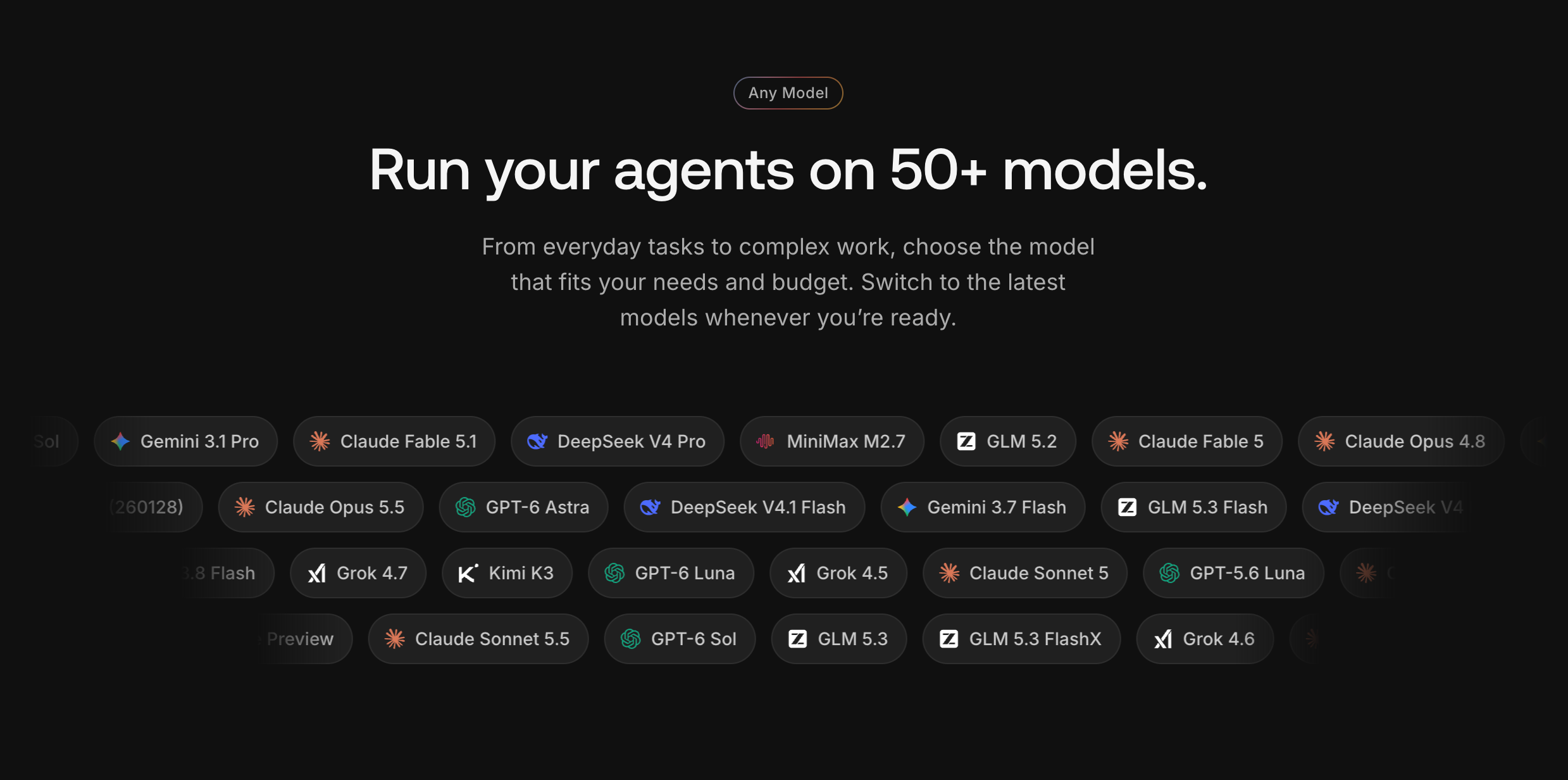
Choosing Astra or Opus answers one part of the workflow: which model to use. In MyClaw, you build AI teammates around the work itself, giving each a role, runtime, tools, and skills on a cloud computer.
For example, configure a PR reviewer to check code changes and a researcher to prepare source-backed briefs. Evaluate the model against the work assigned to that role.
- Create a Teammate for the Job. Start with a role template or define your own. Specify the output, such as a code review with test results and unresolved issues, then provide the relevant files and app connections.
- Choose the Runtime and Model. MyClaw supports runtimes including Codex, Claude Code, OpenClaw, and Hermes Agent. Model choices depend on the runtime. Confirm the exact Astra or Opus version available, then compare results using the same brief and starting files wherever possible.
- Put the Teammate to Work. Assign a task, review the result, and refine its instructions. For repeated work, set a schedule. Check MyClaw pricing and the model charges for your setup before expanding usage.
Conclusion
Choose Opus 5.5 first when lower token rates and predictable long-context pricing are the main constraints. Put GPT-6.2 Astra on your shortlist for difficult reasoning and professional deliverables, supported by its stronger overall evaluation results. For coding, let the patch, tests, and review effort determine the winner. Start with one representative job, repeat it under comparable conditions, and compare total charges alongside the time you spend correcting the result. Keep the model that reliably meets your requirements. In MyClaw, build a teammate around that job, then choose the runtime and model that suit its role.
Skip the Setup, Run Best-in-Class AI Agents Now
Launch a managed OpenClaw or Hermes Agent workspace in minutes, with always-on hosting, updates, and support handled by MyClaw.
Get Started